The future of Australia’s flock starts with ewe lambs
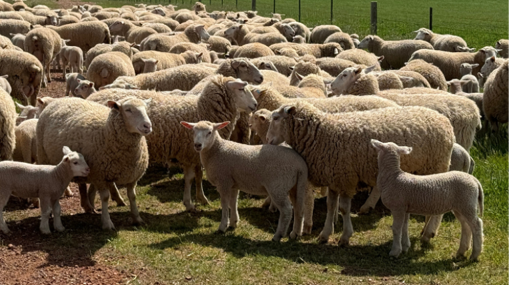
Ewes and lambs at Hills Park, Yerong Creek, NSW where targeted ewe-lamb management is helping drive productivity, reproductive performance and long-term flock resilience. Image supplied.
For sheepmeat producers, sustainability is often built through the everyday management decisions that improve animal performance, make better use of available feed and strengthen the resilience of the business.
A recent Meat & Livestock Australia (MLA) producer case study featuring Andrew and Jane Hunter from Hills Park at Yerong Creek, NSW, demonstrated how targeted management of ewe lambs can deliver benefits across productivity, reproductive performance and whole-farm efficiency.
The Hunters run more than 4,000 self-replacing maternal composite ewes with a strong focus on producing heavy lambs.
Through participation in an MLA Producer Demonstration Site, they examined how better management of ewe lambs during critical stages of growth could improve lifetime performance.
Setting young ewes up for success
Ewe lambs represent the future productivity of a breeding flock, but their performance can be heavily influenced by nutrition and management during the early stages of life.
By focusing on liveweight, growth and nutritional requirements, the Hunter’s have been able to make more informed decisions about when and how ewe lambs are joined and managed.
The goal is not simply to achieve an immediate reproductive outcome. Better early management can help set animals up for stronger lifetime productivity, supporting more consistent reproductive performance and a more efficient flock overall.
Productivity and sustainability go hand in hand
For sheepmeat businesses, improved productivity can also contribute to sustainability.
When more animals reach target weights, reproductive performance improves and feed resources are used more effectively. Producers can generate more value from the same underlying production system.
This can help improve business resilience while reducing inefficiencies across the flock. It is a practical example of why sustainability in sheep production cannot be considered separately from productivity and profitability.
A sustainable enterprise needs animals that perform well, production systems that respond to seasonal conditions and businesses that remain financially viable over the long term.
Better decisions through better data
The case study also demonstrated the value of measuring performance and using evidence to guide management decisions.
Tracking liveweight and reproductive outcomes allows producers to better understand what is working within their own production system and identify where changes may deliver the greatest benefit.
This approach to continual improvement is an important part of sustainable sheep production.
Rather than relying on a one-size-fits-all approach, producers can use data, research and practical experience to refine systems that suit their environment, animals and business objectives.
Building a resilient sheepmeat industry
The Sheep Sustainability Framework recognises that the long-term sustainability of Australia's sheep industry depends on progress across animal wellbeing, environmental stewardship, people and communities, and economic resilience.
Producer examples such as Hills Park show how these outcomes can be interconnected.
Investing in the health, growth and reproductive performance of young ewes can support better animal outcomes while also strengthening productivity and profitability.
For the wider sheepmeat industry, these practical improvements contribute to a more efficient, adaptable and resilient production system – and help demonstrate how sustainability is being delivered on Australian farms.
This article draws on Meat & Livestock Australia's producer case study, Setting ewe lambs up early for smoother seasons ahead, published in July 2026.
More information
Contact:
Resources: