Why shearing training matters more than ever for welfare and sustainability

Why shearing training matters more than ever for welfare and sustainability

April 16 2026

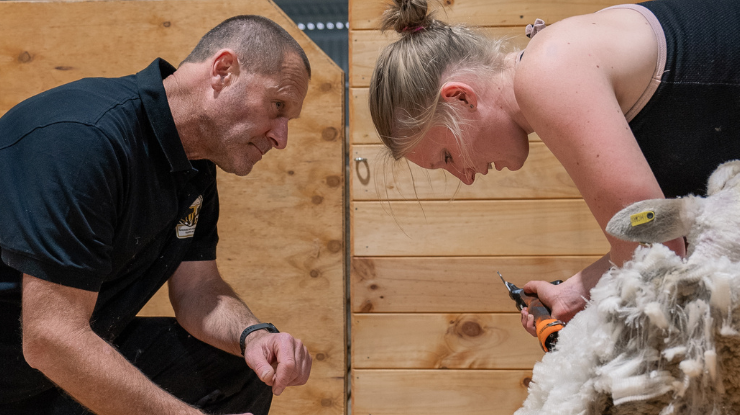
Caption: Glenn Haynes (right) from the Shearing Contractors Association of Australia (SCAA).

Shearing training is a key driver of animal welfare, workforce capability and the long-term sustainability of Australia’s sheep industry.

Within the Sheep Sustainability Framework (SSF), the number of days shearing trainers spend in woolsheds is used as an indicator of how the industry is maintaining and building these capabilities over time.

This metric provides valuable insight for sustainability reporting, reflecting both ongoing investment in workforce development and the consistent application of best-practice shearing standards.

Understanding the latest data

The 2025 Sheep Sustainability Framework (SSF) Annual Report shows the total trainer days in woolsheds declined from 925 days in 2024 to 840 days in 2025.

According to Craig French, Program Manager for Wool Harvesting Training at Australian Wool Innovation (AWI), this change reflects a normalisation following a period of elevated investment.

“The training budget was reduced after increased investment during COVID-19, when demand for shearers and training was particularly high,” he said.

This context is important when interpreting the data, with the recent decline representing a recalibration rather than a reduction in the importance of training.

During COVID-19, AWI increased investment in shearing training to address workforce shortages caused by travel restrictions, including programs to attract and support new entrants. As conditions have stabilised, training activity has returned to levels more aligned with current demand.

Building a skilled and adaptable workforce

Australia’s shearing training system spans multiple levels, from new entrants through to experienced and advanced shearers, with a strong emphasis on consistency and adaptability.

“We’re trying to train to a consistent technique so shearers can work anywhere in the world, on any type of sheep, and do a high-quality job,” Mr French said.

Training delivery is also responsive to industry conditions, adjusting as workforce supply and demand changes.

“At the moment, we have a relatively good supply of experienced shearers, so demand for new entrants is lower, but that can change quickly,” Mr French said.

Glenn Haynes from the Shearing Contractors Association of Australia (SCAA) said structured training pathways are lifting capability across the workforce while supporting long-term industry needs.

“When you put that level of experience together, you’re constantly looking years ahead at what the industry needs,” he said.

Programs increasingly incorporate not only technical skills, but also physical conditioning, workplace safety and broader career development, contributing to a more resilient and professional workforce.

Why training is a sustainability indicator

Shearing is a direct point of interaction between people and animals in the sheep production system, making it highly relevant from both an animal welfare and public perception perspective.

Training ensures shearers develop consistent techniques and patterns that minimise stress on sheep, reduce the likelihood of cuts and support the removal of wool in a single, clean fleece.

“Our first priority is animal welfare, to shear sheep as cleanly as possible and avoid cuts,” Mr French said. “The second is improving the quality of the wool clip.”

From an on-ground perspective, Mr Haynes said technique plays a direct role in both welfare and efficiency outcomes.

“If the shearer is doing it easier and the sheep are sitting comfortably, they’re not kicking,” he said.

“The stress on the sheep and the stress on the shearer go hand in hand.”

These outcomes extend beyond welfare, influencing clip quality, processing efficiency and overall supply chain value.

Looking ahead

The SSF shearing training indicator underscores the importance of maintaining the right balance between investment, demand and workforce capability.

From a sustainability perspective, the focus remains on ensuring consistent, high-quality training that supports animal welfare, workforce retention and industry resilience.

In a dynamic production environment, training programs will continue to evolve in response to seasonal conditions, sheep numbers and labour demand.

“We adapt training to what the industry needs,” Mr French said.